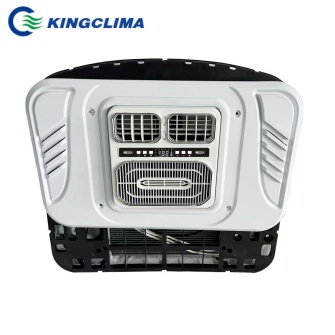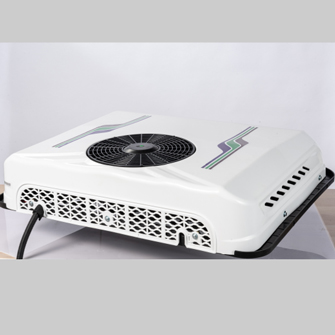
A 12V truck air conditioner looks simple from the driver's seat: one box, one skylight, one switch. On the production line, it is a set of tolerances — a condenser 26 mm thick that still has to move serious air, a refrigerant charge measured in grams, a voltage cutoff that must trip at exactly the right point to protect a battery the customer never wants to replace. The CoolPro2800 is built around those tolerances, at a scale of around 70,000 vehicle HVAC units a year. Here is what that line has to get right, and why each point shows up on the datasheet.
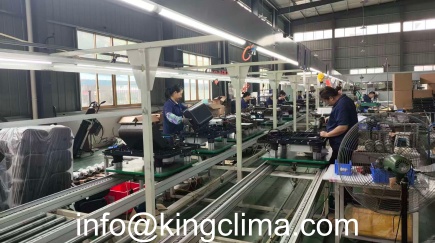
The CoolPro2800's defining feature is that it replaces a truck cab skylight — no slotting, no structural cutting, an install many drivers complete themselves. That is only possible if the housing comes off the line at a consistent 900 × 804 mm footprint, run after run. Dimensional consistency is a production discipline, not a design drawing: mold wear, assembly jig drift and paint build all push a housing out of tolerance, and any of them turns a skylight swap into a body-shop job. This is why the footprint is quoted to the millimeter — and why the line checks it, not just the drawing.
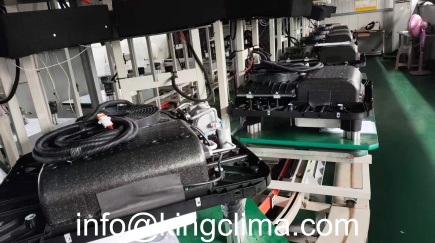
The condenser is a parallel-flow, double-fin coil measuring 464 × 376 × 26 mm. Parallel flow is the only architecture that delivers this cooling duty in that thickness: refrigerant runs through parallel micro-channels instead of a serpentine, so pressure drop stays low while the fin surface does the work. Building one is straightforward. Building thousands that all perform the same requires controlled brazing and fin density — the invisible work behind the spec, and the reason a brushless 100W fan moving 1,300 m³/h is enough.
The R134a charge is 550 grams. At that scale, a few grams of over-charge or under-charge is the difference between rated capacity and a customer complaint, and a bad braze joint is a warranty unit. Refrigerant charging on a responsible line is weighed, not guessed, and every unit is leak-checked before it ships. There is a horizon to this as well: R134a is an HFC, and HFC supply is stepping down under the AIM Act's HFC reduction program — a manufacturer that controls its own charging process can adapt charge specifications as refrigerants evolve.
Three numbers leave the line only after calibration. First, the low-voltage protection trips between 19 and 22V — set too low, it deep-discharges the truck's batteries; set too high, it cuts cooling early and the driver disables it. Second, the PWM control that modulates compressor speed has to hold its frequency range, because the advertised 10-hour endurance at intelligent frequency control only materializes when the unit actually throttles down at temperature. Third, battery health itself depends on how the unit behaves at the margins — depth of discharge is what kills truck batteries, as battery charging practice makes clear.
KingClima has manufactured vehicle air conditioning and transport refrigeration since 2003 — over 20 years — with an annual output of around 70,000 units and 7×24 online after-sales support. The same line discipline produces the CoolPro2800 in three colors — red, blue and white — without letting finish variation become dimensional variation. At 27.69 kg per unit, consistency is what lets a fleet order a hundred and install them without surprises.
When you compare a 12V/24V rooftop unit, ask what is behind the datasheet: is the condenser actually parallel flow, is the charge weighed, is the cutoff calibrated per unit? The CoolPro2800 truck cab air conditioner page lists the answers; the production line is where they become true. Fleets specifying sleeper-cab cooling across mixed truck brands can request the broader truck air conditioning range for units matched to different cab architectures — and contact us with cab type and battery configuration before ordering.