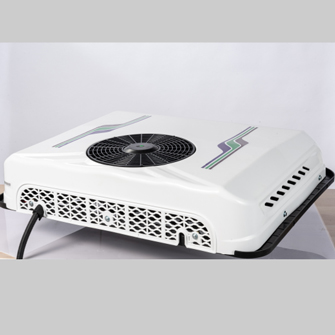
For RV travel enthusiasts—especially those wishing to break free from the constraints of established campgrounds—the electricity consumption of an RV air conditioner is a critical issue that simply cannot be ignored. To enjoy a cool breeze while out in the wilderness, you must first understand where your power comes from, exactly how much electricity the AC draws, and how to manage your energy usage efficiently. This article clearly breaks down this topic for you across four key dimensions: power supply, power consumption, energy conservation, and equipment selection.
What Are the Power Sources for RV Air Conditioners?
An RV air conditioner cannot be powered for extended periods using a standard lead-acid battery alone. To achieve off-grid cooling, a comprehensive electrical system is required to provide the necessary support.
There are three common methods for powering an RV air conditioner: First, campground shore power—this is the most hassle-free option, though it is limited to designated campsites. Second, gasoline or propane generators—these offer ample power but are noisy and consume fuel. Third, a combination of batteries and solar power—this represents the current trend toward the quietest and most eco-friendly solution. If you intend to power your air conditioner using batteries, Lithium Iron Phosphate (LiFePO4) batteries are currently the only practical choice. Additionally, you must equip your system with a pure sine wave inverter, as the compressor within an air conditioner places extremely high demands on the quality of the electrical current. Taking a common, medium-output air conditioner as an example: to keep it running for an entire night, you typically require a battery bank with a capacity of at least 300 amp-hours, paired with an inverter rated at approximately 3,000 watts to withstand the surge in current that occurs during startup.
Does Running an RV Air Conditioner Consume a Lot of Electricity?
When assessing the power consumption of an RV air conditioner, you cannot rely solely on its rated power output; the instantaneous current drawn during startup is significantly higher than that required for steady-state operation. The power demand during startup is typically two to three times that of the running power—this is the fundamental reason why many users encounter issues such as their inverter "tripping" or their generator becoming "overloaded." Using the most common model on the market—a 13,500 BTU RV air conditioner—as an example: its power draw during steady-state operation ranges from approximately 1,200 to 1,600 watts, translating to an energy consumption of about 1.3 to 1.5 kilowatt-hours (kWh) per hour. However, if you account for the peak demand during startup, the power draw can briefly surge to over 3,000 watts. Based on an estimate of eight hours of operation per night, the air conditioner alone would consume between 10 and 12 kWh of electricity. This figure represents a substantial burden on an RV's battery system—equivalent to consuming the vast majority of the usable capacity within a 600 amp-hour lithium battery bank. Therefore, blindly increasing battery capacity is not the only solution; understanding power consumption patterns is the essential first step.
Are There More Energy-efficient Methods Available?
First is physical insulation—arguably the most underestimated energy-saving strategy. Installing reflective sunshades on windows, inspecting door seals, or even applying a heat-reflective coating to the roof can significantly reduce the loss of cool air. In many cases, a well-insulated RV consumes over 30% less electricity than an identical model lacking proper insulation. Second are smart usage techniques. Avoid waiting until the scorching midday sun to switch on the AC; instead, try to pre-cool the cabin in the early morning or late evening. Maintaining a constant temperature is far more energy-efficient than attempting to rapidly cool down an interior that has already reached extreme temperatures. Additionally, utilizing small circulation fans to assist airflow allows you to feel just as comfortable even with the AC thermostat set two degrees higher. Finally, there are equipment-level enhancements. Installing a "soft start" device is currently recognized as one of the most cost-effective upgrades available. It reduces the AC's initial surge current by more than half, enabling you to power your existing air conditioner with a smaller inverter or generator. Furthermore, regularly cleaning air filters and keeping the evaporator coil clean are fundamental practices for maintaining energy efficiency.
Choosing the Right RV Air Conditioner
When shopping for an RV air conditioner, first clarify your specific usage scenarios. If you spend the vast majority of your time parked at campgrounds equipped with electrical hookups, a traditional rooftop AC unit will suffice; your primary considerations should simply be cooling speed and noise levels. However, if you frequently engage in off-grid camping, you need to be more discerning. Prioritize models with high energy efficiency—units that deliver the same cooling output while consuming less electricity. Another avenue worth exploring is inverter-based air conditioners or models featuring variable-speed compressors. These units automatically adjust their operating power output based on temperature fluctuations, thereby avoiding the unnecessary energy waste and electrical surges associated with the frequent start-stop cycles of traditional fixed-frequency AC RV air conditioner units. Additionally, if a soft-start function is already integrated into the AC unit itself, it saves you the hassle of installing an aftermarket add-on later. Some high-end, off-grid-specific air conditioners can even maintain a steady temperature while drawing as little as a few hundred watts of power—making them an ideal match for solar power systems. Finally, be sure to select an air conditioner with a cooling capacity appropriate for the size of your RV. For small RVs under 20 feet, 13,500 BTU is sufficient to handle most summer conditions; for medium-sized RVs between 20 and 30 feet, 15,000 BTU is the standard; and for larger vehicles exceeding 30 feet, you may need to consider a dual-unit setup or a single, more efficient high-capacity unit.



.png)

.jpg)
.png)