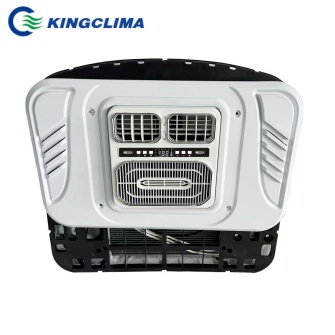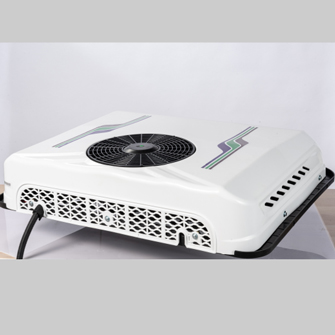
Fleet buyers compare truck cab air conditioners by datasheet: cooling capacity, voltage, weight, dimensions. But a datasheet is a promise, and the production line is where promises are either kept or quietly lowered. Having built vehicle air conditioning since 2003, we can be specific about the four checks a unit like the CoolPro2800 has to pass before it earns a place on a truck roof — because each one is visible in the finished product if you know where to look.
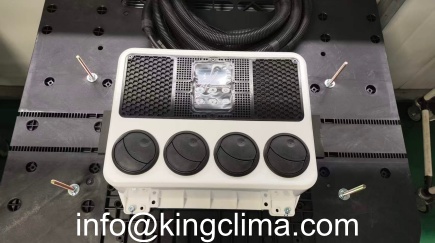
The CoolPro2800 is rated at 2,800W — 9,500 BTU — roughly the cooling output of a 1.5-horsepower household split unit, from a box 160 mm tall. Verifying that number is not a formality: capacity depends on the parallel-flow, double-fin condenser (464 × 376 × 26 mm) rejecting heat through a 26 mm-thick core, with a brushless 100W fan moving 1,300 m³/h across it. If the brazing is inconsistent or the fin density drifts between batches, the rated capacity quietly becomes fiction. A line that measures capacity on finished units keeps the datasheet honest; a line that does not, lowers the number and hopes nobody notices.
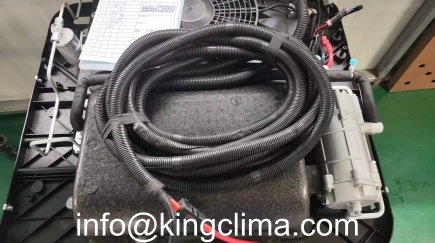
This is the check fleet managers should care about most, because it is the one that protects their maintenance budget. The CoolPro2800 disconnects automatically when battery voltage falls to 19–22V — precisely the band where a 24V system approaches the minimum needed to restart the engine. Calibration matters at both ends: set too low and the unit deep-discharges the batteries; set too high and drivers lose hours of cooling and start bypassing the protection entirely. Depth of discharge is what kills truck batteries — the same principle documented in lead-acid charging practice — so a cutoff that is calibrated per unit, not per batch, is worth asking any supplier about.
The datasheet claims 10 hours of cooling. The important qualifier is on the same line: at intelligent frequency control. The electric scroll compressor (DC24V, 20 cm³/r, 1,000–4,000 rpm) is driven by PWM, and it is the throttling — down to 250 m³/h of evaporator airflow once the cab reaches temperature — that stretches a battery bank through a rest period. A factory that verifies the PWM control actually modulates, rather than runs flat out, is the reason the claim holds. Without that discipline, "10 hours" becomes whatever the marketing department wrote.
The CoolPro2800 installs by replacing a truck cab skylight — no slotting, no structural cutting. That install story depends on the housing holding its 900 × 804 mm footprint and 27.69 kg weight across thousands of units. The streamlined, CFD-optimized shell also has to survive the line: three color options — red, blue and white — move through the same process without dimensional drift. Fleets installing dozens of units per season feel this check directly: every skylight opening accepts every unit, and no technician re-cuts anything.
KingClima has manufactured vehicle air conditioning and transport refrigeration since 2003 — over 20 years — with an annual output of around 70,000 units and 7×24 online after-sales support. The CoolPro2800 truck cab air conditioner sits in the parking-cooler family alongside our parking air conditioners, built on the same in-house compressor and heat-exchanger discipline, with replacement parts available so a five-year-old unit is serviceable, not disposable.
Ask any supplier four questions: Is capacity measured on finished units? Is the low-voltage cutoff calibrated per unit? Does the PWM control actually modulate? Is the skylight footprint held to the millimeter? If the answers are confident and specific, the datasheet is real. If you would rather skip the interrogation, send us your cab type and battery configuration — the unit was built to answer them.